We Burned the Old Grove. What Grew Back Was Hope.
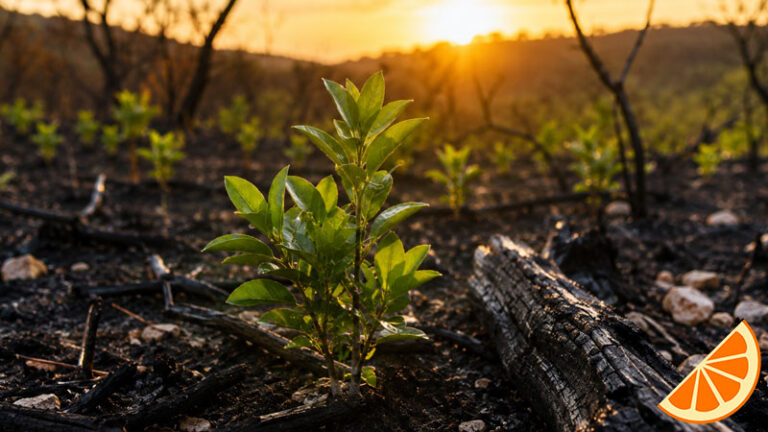
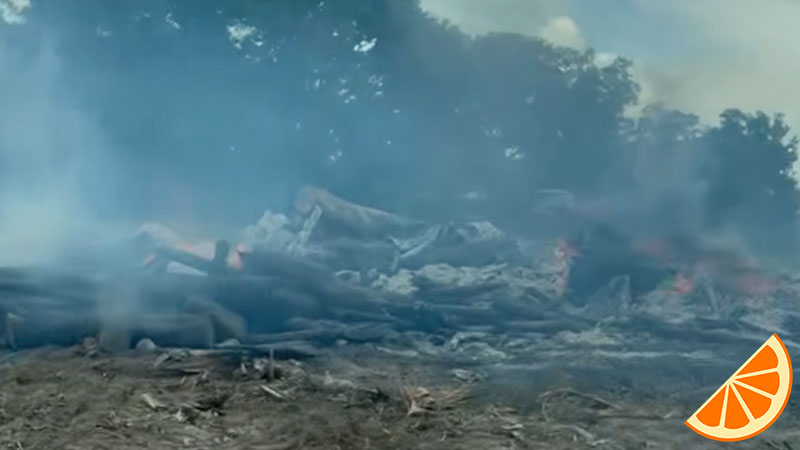
There’s a moment, when the smoke rises above the tree line and the orange light of the fire catches the late afternoon haze over Lake County, that it doesn’t feel like farming. It feels like a funeral.
The trees we burned this season have been in this ground for years. They didn’t die from neglect. They didn’t fail because anyone gave up on them. They were killed by Huanglongbing — citrus greening — the bacterial disease that has quietly dismantled nearly 70 percent of Florida’s citrus industry over the past two decades. There is no cure. There is no saving a tree once it’s infected. The only move left is to take them down, burn what remains, and prepare the ground for what comes next.
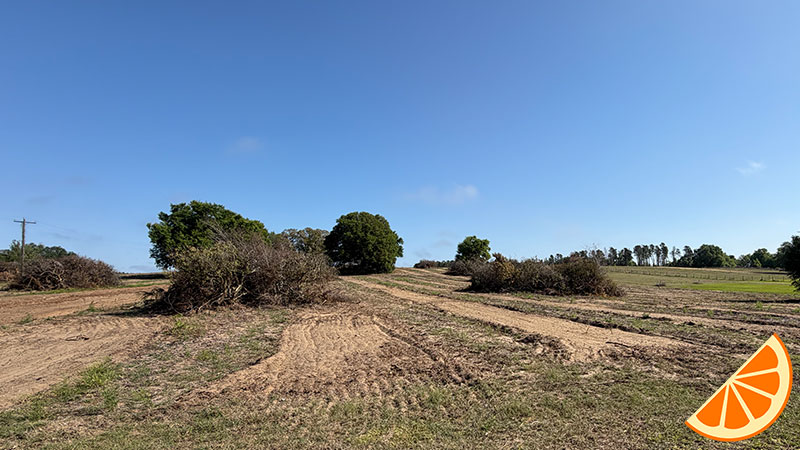
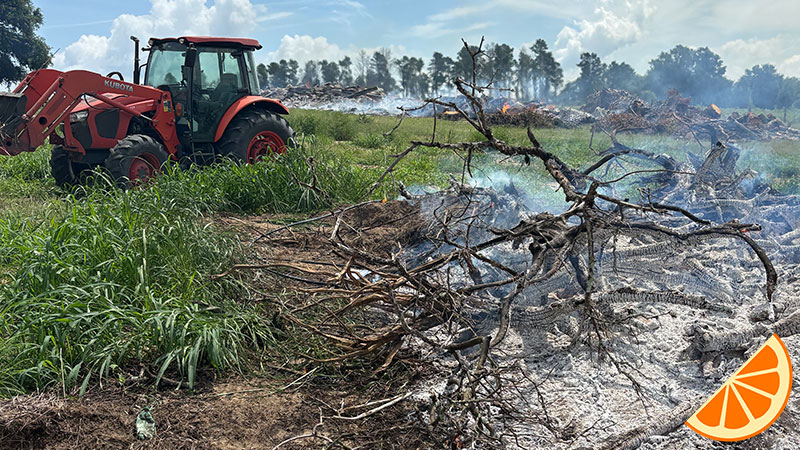
That’s what you’re looking at in the photos and video from this season. Not destruction. Preparation.
The ground that fed a citrus grove for generations is still here. Still alive. We’re just giving it a new tree to take care of.
Why We Burn Instead of Bulldoze
When citrus trees die from HLB, the root systems, wood, and organic material harbor disease vectors — most critically, the Asian citrus psyllid, the insect that carries and spreads the HLB bacteria from tree to tree. Simply pushing the wood into a pile or chipping it on-site leaves those vectors in the grove and in the soil.
Controlled burning eliminates that risk. The heat destroys the organic debris completely, kills insect populations in the material, and sterilizes the immediate soil surface. It’s one of the most effective tools an organic grower has for breaking the HLB disease cycle before replanting — and it’s been used in Florida citrus for generations.
But burning does something else that doesn’t get talked about enough. It gives back.
What the Ash Puts Back Into the Soil
Wood ash from citrus trees is not just debris. It’s a concentrated mineral deposit — everything the tree drew from the soil over its lifetime, distilled down to a fine gray powder and returned to the earth at once.
Florida’s sandy, low-organic-matter soils benefit significantly from ash application. Here’s what the science shows is going back into the ground:
- Calcium (Ca) 20–35% Strengthens cell walls, improves root development, raises soil pH
- Potassium (K₂O) 3–8% The #1 fruit quality mineral — regulates water, sugar, and brix levels in fruit
- Phosphorus (P) 1–3% Root growth, energy transfer, flower and fruit set
- Magnesium (Mg) 1–3% Core component of chlorophyll — drives photosynthesis and leaf color
- Manganese & Zinc Trace Micronutrient support for enzyme function and disease resistance
- Sulfur (S) Trace Protein synthesis, organic matter breakdown
- Nitrogen (N) 0% Volatilizes in the fire — must be added separately at planting
The pH Effect
Wood ash is strongly alkaline — it functions similarly to agricultural lime, raising soil pH. Florida’s sandy citrus soils tend toward moderate acidity. Citrus thrives at pH 6.0–7.0. A targeted ash incorporation, calibrated to the existing soil pH, is one of the most cost-effective ways to naturally correct and stabilize soil chemistry before planting.
This is why we test the soil after burning and before we seed the cover crop — we need to understand what the ash contributed before we add anything else.
Seeding Into the Ash: The Cover Crop Bridge
The ash doesn’t work alone. Once the burn is complete and the material has cooled and settled, the next step is establishing a cover crop across the cleared ground — seeded directly into the ash-amended soil.
Cover crops serve multiple purposes in the window between clearing and fall planting. They prevent erosion of the freshly disturbed sandy topsoil. They fix nitrogen back into the ground — the one major nutrient the fire removed. They establish the fungal and microbial networks in the soil that new tree roots will need from day one. And they keep the weed pressure managed without herbicides, which is essential on a certified organic operation.
The cover crop varieties we’re seeding this season are selected specifically for Florida summer conditions and for what the new grove will need: nitrogen-fixing legumes like sunn hemp, deep-rooting daikon radish to break up compaction, and flowering species that will begin building the pollinator habitat the grove will depend on at blossom time.
By the time the fall planting window opens, this ground won’t look like a burn site anymore. It will look like a grove that’s been waiting.
Working With the State: The Florida Department of Agriculture and Consumer Services
Clearing a citrus grove under HLB protocols isn’t just a matter of deciding to do it. In Florida, the severity of citrus greening has prompted a coordinated state and federal response — one that involves regulatory oversight, replanting assistance programs, and science-based guidance at every step.
We’ve been working closely throughout this process with the Agriculture and Consumer Protection Specialist at the Division of Plant Industry within the Florida Department of Agriculture and Consumer Services (FDACS). Their involvement has been invaluable — not just in ensuring we’re meeting the regulatory requirements for disease-affected grove removal, but in helping us think through the replanting strategy with the most current science on HLBresistant rootstocks, spacing, and grove design.
The Division of Plant Industry exists precisely for moments like this. When Florida’s citrus industry faces an existential threat — and HLB has been exactly that — the DPI is the institutional knowledge that keeps growers from making expensive, well-intentioned mistakes.
Their guidance on timing, on what varieties are showing the most resilience in new field trials, and on how to structure the new grove for long-term health under continued HLB pressure has shaped every decision we’re making this fall.
We’re not just replanting trees. We’re replanting with fifty years of hard-won research behind every decision.
For growers in Florida who are facing the same situation — infected trees, a cleared block, and the question of what comes next — the FDACS Division of Plant Industry is the right first call. Their citrus health specialists provide free consultation and site visits for registered Florida citrus operations. Don’t replant without them.
Fall Planting: What’s Going In the Ground
The fall planting window is the target. Cooler temperatures, the end of Florida’s heavy summer rain season, and stable soil moisture conditions make fall the ideal time to establish new citrus trees — roots can develop through winter before the heat of the following summer stresses them.
The new trees going into this grove will be 100% certified organic Ruby Red grapefruit — the same variety this land has grown for decades, now on rootstocks selected for performance under current Florida conditions. Every tree that goes in the ground this fall becomes available for adoption.
These are not mature trees. They are young trees, at the beginning of a long life in the ground. The subscribers who adopt them in Year 1 are doing something genuinely significant — they’re anchoring a new grove in its first season, in soil that was cleared, burned, amended, and carefully prepared for exactly this moment.
What to Expect in Year 1
- Trees establish root systems and begin canopy development
- First pruning and training to shape a healthy structure
- Cover crop transitions to mulch and soil amendment
- Subscriber updates include growth photos and soil data
- Fruit begins in Year 3–4 — the early years are all about the roots
Adopting a Year 1 tree is a long-term relationship. It’s also the most significant one — you’re there from the beginning.
What We Learned from the Fire
There is grief in clearing a grove. Ask any citrus farmer who has done it. The trees you’re burning aren’t just trees — they’re years of work, decades of weather and worry, fruit that fed families and paid for college and held a family together through hard years. When they go, something goes with them.
But there is also something clarifying about fire. It reduces things to what remains. And what remains, in this grove, is everything that matters: the soil, the family, the knowledge, and the intention to grow something again.
The ash that’s settling into this ground right now is the beginning of the next chapter. By fall, there will be new trees in the ground. By the time those trees are producing fruit — three, four years from now — the people who adopted them in Year 1 will have watched them grow from the very first season.
That’s what My Fruit Tree is. Not just a fruit subscription. A stake in a story that starts today, with smoke over a Lake County grove and a family that isn’t finished farming yet.
“Farmers don’t retire. They plant trees and let the next generation find out what they were doing.”
-Greg Homan, Lake County, Florida. Citrus grower since 1974.