The Old Trees Are Coming Down. The New Grove Is Going In.
There’s a certain kind of grief that comes with pushing a citrus tree.
The tree doesn’t go down all at once. The root system holds. You push with the bucket, and the tree leans, and the ground tears, and then it’s over. You stack it with the others. You burn it. You move to the next one.
I’ve been doing this for weeks now — clearing the old grove row by row to make room for the new trees going in. And every single tree we’re pushing has the same story.
What Killed These Trees
Huanglongbing. Citrus greening disease. HLB.
It’s a bacterial infection spread by a tiny insect called the Asian citrus psyllid. First detected in Florida in 2005, it has since moved through every major citrus-growing county in the state like something you can’t stop and can’t explain away. Once a tree is infected — and most trees in Florida eventually are — there is no cure. The tree produces less fruit each year. The fruit grows small, misshapen, and bitter. The tree slowly starves to death. And eventually, you push it.
We lost 50 million trees in Florida to this disease. Thirty-three thousand jobs. Twenty billion dollars. The grove you’re looking at in these photos is one small piece of that story.
But it’s not just a loss story. It’s a clearing story.
About These Photos
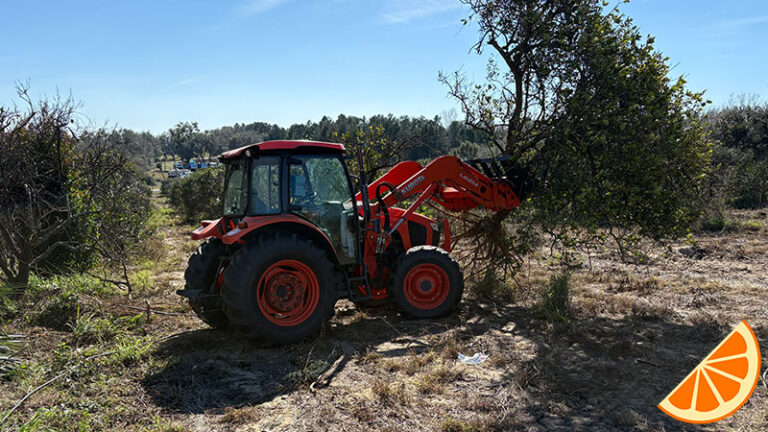
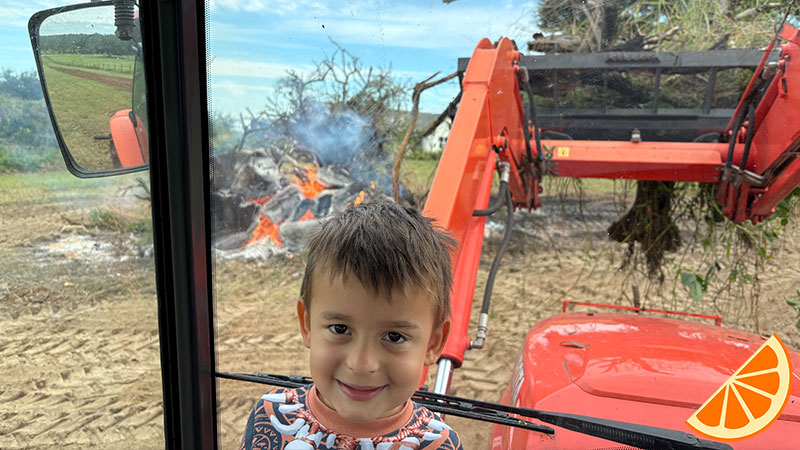
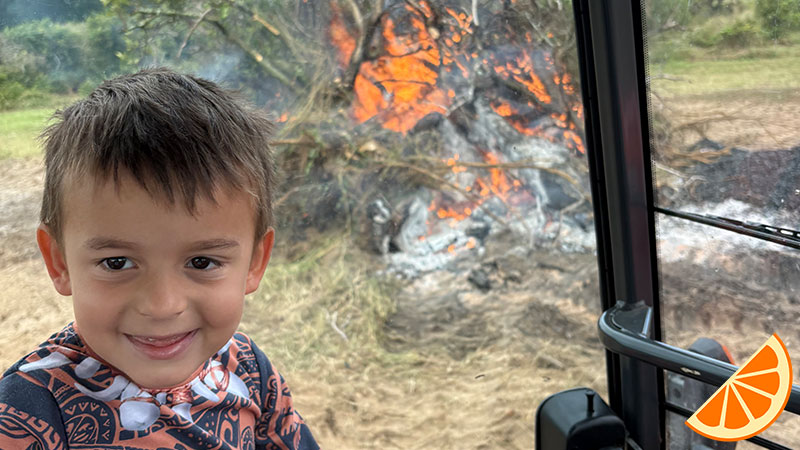
What you’re seeing in these images is the old grove being cleared in preparation for new certified organic Rio Red grapefruit trees. The Kubota tractor is clearing trees killed by citrus greening disease. Once cleared, the stumps and root mass are piled and burned. The ground is then prepared for new plantings. The small face peering through the windshield belongs to Lucas Muszynski — Scott and Lilly’s son, and the youngest member of the My Fruit Tree family. He was in the cab helping push trees the day these photos were taken.
What You’re Looking At
The first photo is taken from inside the cab. Lucas is in the seat, watching the work happen through the windshield. Behind him, a pile of pushed trees is burning. The smoke rises straight up in the still morning air. The ground is sandy and open — already starting to look like something new.
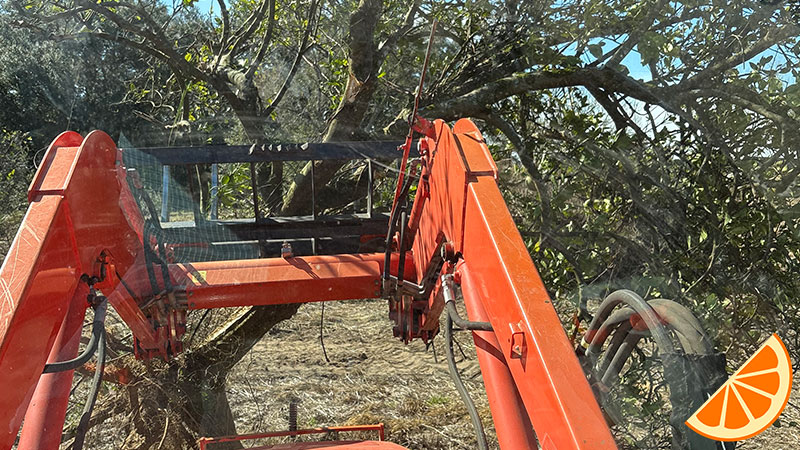
The second photo shows the view from the operator’s perspective — the tractor bucket raised, deep in the row, pushing against the trunk and root ball of another infected tree. The branches are bare. The leaves that remain are yellowed and curled — the unmistakable signs of greening. This tree was already done. We’re just making it official.
The third photo shows the tractor from the outside as it moves through a row where some trees are still standing. You can see the contrast clearly: on the left, bare dead trees stripped of fruit and life. On the right, a few trees are still showing green. Those go next. The disease is in all of them.
Why We’re Burning
When citrus trees infected with HLB are removed, you burn them. You don’t compost, you don’t chip, you don’t leave them piled. You burn — because the Asian citrus psyllid that carries the disease lives in the leaf tissue, and if you leave infected material on the ground, you’re just replanting the problem.
The fire is not dramatic. It’s practical. It’s what you do when you’re serious about what comes next.
And we are very serious about what comes next.
“Every tree we push is one less obstacle between this ground and something healthy. We’re not mourning the old grove. We’re making room.”
What Goes In Next
New Rio Red / Ruby Red grapefruit trees. Certified organic. Newly propagated, disease-free stock.
The new variety we’re planting has been selected specifically for its flavor profile and its resilience in Florida’s climate. These aren’t the same trees as before. They go into ground that’s been cleared, rested, and prepared properly.
And they go in with names on them.
That’s the part that’s different this time. Every one of the 1,000 adopt-a-trees we plant will belong to a subscriber. The plaque at the base will have their name on it. They’ll get a photo of their tree in the ground. They’ll watch it grow through the seasons. And in Year 3, they’ll eat from it.
This isn’t just replanting a grove. It’s replanting it with a community.
A Note About Lucas
Lucas Muszynski is four years old. He is Scott and Lilly’s son, and on the day these photos were taken, he spent the morning in the tractor cab — seriously invested in the work happening outside the windshield.
He doesn’t know yet that the trees going in this year will be producing fruit when he’s in high school. He doesn’t know that the grove he’s helping clear is one his family will tend for decades. He just knows the tractor is big and the fire is interesting and there’s a lot going on.
That’s enough for now.
The Ground Is Ready. Your Tree Is Next.
We are clearing this ground right now for the new certified organic grove going in this season. Founding Member adoption spots are open — and limited. Your tree will be planted in the very rows you’re looking at in these photos. Your name will go on a plaque in the ground. Your harvest will come in Year 3.
You’re not watching this from a distance. You can be part of it.